A UPVC front door leaking at the bottom during rain is almost always a threshold problem, not a fault with the door panel itself. Water is getting past the seal at floor level, through blocked drainage, or under a missing drip bar, rather than through the door or the glass.
The fix depends entirely on which of those three it is, so here’s how to tell them apart before booking anyone out.
A leak that only shows up during heavy or wind driven rain, never on a still day, points to the threshold seal rather than the door panel
Blocked or missing drainage holes along the outer threshold are one of the simplest and cheapest causes to check yourself
An inward opening door will always let a small amount of water sit at the seal line in driving rain, this is normal design behaviour rather than a fault, unless it’s actually getting through
A missing or damaged drip bar under the door lets water track straight back along the underside of the frame
Water that appears gradually, minutes into a downpour rather than immediately, usually means it’s overwhelming the drainage rather than pouring straight through a gap
Why Doors Leak at the Bottom More Than Anywhere Else
The bottom of any external door takes more punishment than any other part of the frame. It sits closest to ground level, catches splashback from the path or step below it, and has to manage the full weight of water running down the entire face of the door every time it rains.
Manufacturers build in a threshold specifically to manage this, a raised strip that the door seals against, usually with small drainage channels built into the outer edge to let water escape back outside rather than pool against the frame. When any part of that system fails, whether that’s the seal compressing unevenly, the drainage getting blocked, or the threshold itself sitting at a slight angle it was never meant to sit at, water finds the path of least resistance, which is usually straight into your hallway.
Inward Opening Doors Behave Differently to Outward Opening Ones
If your front door opens inward, a small amount of water sitting between the door and the frame above the seal line during heavy, wind driven rain is a known characteristic of the design rather than automatically a fault. The physics are straightforward. Rain running down the face of the door reaches the bottom seal, which stops the bulk of it, but a thin film can still sit briefly in that gap before draining away. The moment that door is opened, whatever is sitting there follows gravity inward.
This matters because it changes what “leaking” actually means for your door. A door that lets in a trace of water only when it’s opened straight after driving rain is behaving normally. A door that’s letting water through while it stays fully closed, or one that keeps leaking well after the rain has stopped, has an actual fault rather than a design quirk.
The Three Most Likely Causes, and How to Check Each One
Blocked or Missing Drainage Holes
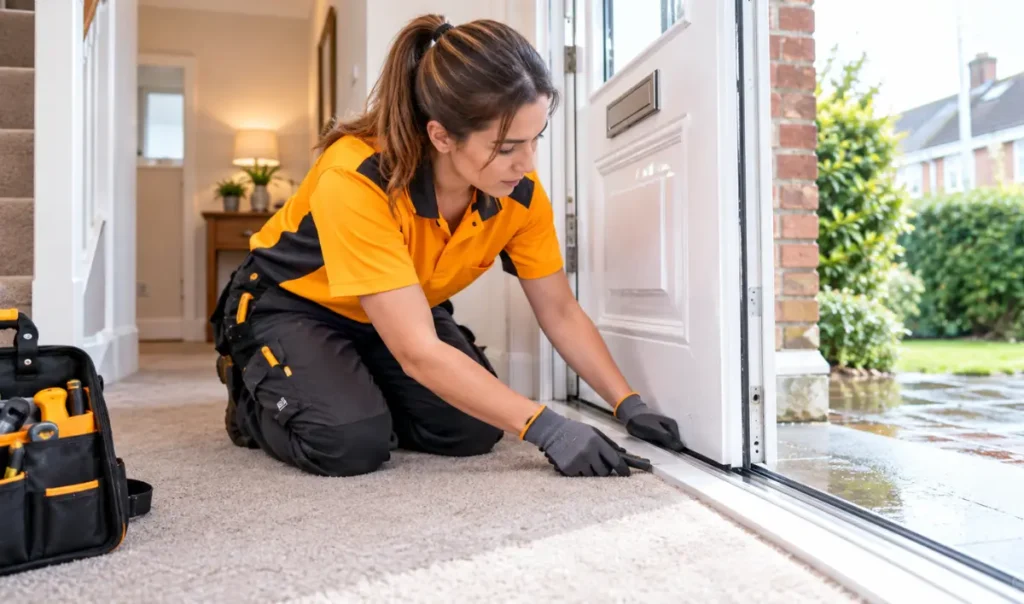
Most UPVC thresholds have small drainage slots along the outer edge, designed to let any water that gets past the outer seal drain straight back outside. These block easily with dirt, leaves, or general debris, especially on a door that doesn’t get swept or cleaned regularly.
This is the easiest cause to rule out yourself. Look along the outside of the threshold for small slots or gaps and check whether they’re clear or packed with grime. If they’re blocked, clearing them is often enough on its own to solve a leak that had been building gradually over several rainy weeks.
A Missing or Damaged Drip Bar
A drip bar sits underneath the door slab itself, along the bottom edge, and its job is to stop water tracking back along the underside of the door and behind the threshold rather than falling straight down and away. Where one is missing entirely, damaged, or was never fitted correctly during installation, water can travel further back than the threshold was ever designed to handle.
This is harder to check without removing or getting underneath the door, so it’s usually one for a glazier to confirm rather than something to inspect from the outside yourself.
A Threshold Seal That’s Compressing Unevenly
Over years of foot traffic and repeated opening and closing, the compression seal along the threshold can wear unevenly, often lower in the middle where feet cross most often than at the edges. A door that seals perfectly at both sides but has a slight gap in the centre will let water through specifically at that low point, which can look confusing if you’re checking the door edges rather than the middle of the threshold itself.
Common Mistakes That Make the Leak Worse
Sealing around the entire threshold with silicone as a first fix, before working out where the water is actually getting in, is one of the most common mistakes homeowners and even some fitters make. If drainage holes get sealed over in the process, water that used to escape outside now has nowhere to go except inward, which can turn an intermittent leak into a constant one.
Assuming a new door can’t possibly be the cause is another mistake worth avoiding. A threshold fitted slightly out of level, or a door hung with a fraction too little compression against the seal, can produce exactly the same leak as an old, worn one, and it’s a more common cause on recently installed doors than most homeowners expect.
Ignoring a leak because it only happens in heavy storms is understandable but tends to backfire. Water that’s finding its way in during the worst weather is often already finding a smaller way in during lighter rain too, just not in a volume anyone notices yet, and the damp that builds up unseen around a threshold over several seasons is far more costly to put right than the original leak would have been.
Frequently Asked Questions
Is a small amount of water on an inward opening door always normal?
A trace of water at the seal line when the door is opened straight after heavy rain can be normal for an inward opening design. Water that’s present while the door stays closed, or that keeps appearing well after the rain has stopped, points to an actual fault rather than expected behaviour.
Can I fix a leaking threshold myself?
Clearing blocked drainage holes is a straightforward job most homeowners can do safely. Anything involving the threshold itself, the drip bar, or the seal compression usually needs a proper inspection, since sealing over the wrong spot can trap water rather than keep it out.
Does new flooring or a raised step outside affect this?
Yes. Ground level that’s been built up close to the threshold, whether that’s a new path, a raised patio, or even a thick doormat sitting against the door, can stop water draining away properly and push it back toward the seal instead. It’s worth checking what’s changed outside the door as much as what might have changed with the door itself.
Why does the leak only happen a few minutes into heavy rain, never straight away?
This timing usually points to drainage being overwhelmed rather than a straightforward gap. Water is getting past the outer seal at a normal, expected rate, but instead of clearing away through the drainage holes as fast as it arrives, it’s backing up until it eventually finds its way over the top and inside.
Could this actually be condensation rather than rain getting in?
It’s worth ruling out, though the pattern usually makes it obvious. Condensation builds gradually from indoor humidity and has no connection to what’s happening outside, while a genuine leak tracks closely with the weather, appearing during or shortly after rain rather than at any random time. Our guide on water appearing on a windowsill after rain covers the same timing test in more detail if you’re not certain which one you’re dealing with.
If your front door is letting water in and clearing the drainage holes hasn’t solved it, it’s worth having the threshold and seal properly checked before the damp spreads any further. Our UPVC door repair service can identify exactly which of the three causes is behind it, and where the door itself needs attention rather than just the threshold, our composite and double glazed door repair team can take it from there.