
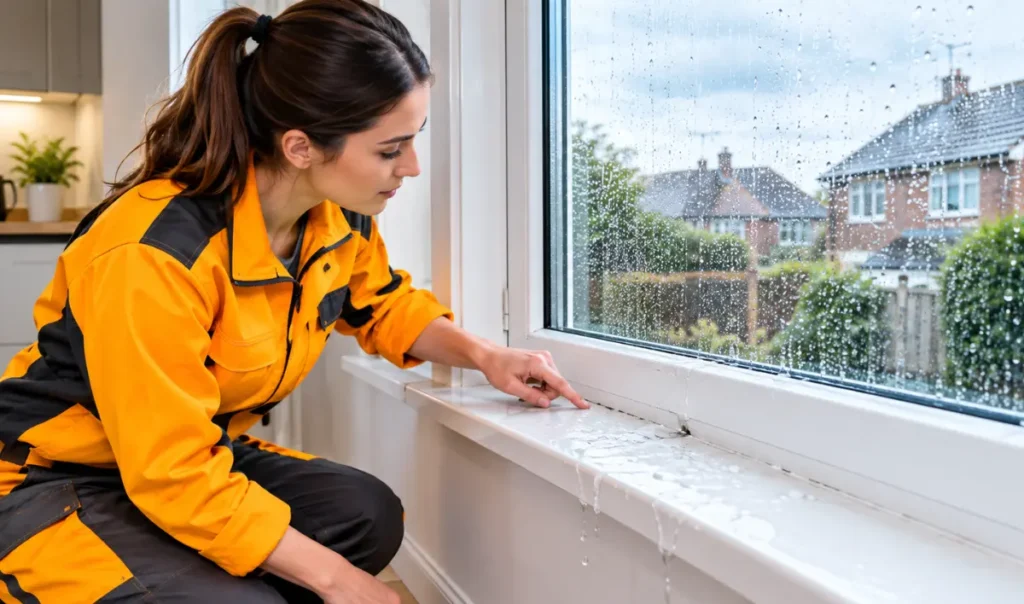
If a puddle appears on your windowsill specifically during or straight after rain, that points to water coming in from outside, not condensation forming on the inside. Condensation builds gradually from room humidity meeting a cold surface and has no direct connection to what the weather is doing outside at that exact moment, while genuine rain ingress tracks closely with the weather, appearing during a downpour or within minutes of one ending.
Getting this distinction right matters, because the two problems sit in completely different parts of the window and need entirely different fixes. Southampton’s exposure to wind driven rain off the Solent makes this a genuinely common question, and it’s one Glaze Repair’s team fields regularly across the city once the autumn and winter storms start rolling in.
What’s Actually Happening in Each Case
Condensation forms when warm, moist air inside a room meets a colder surface, usually the glass itself, and the moisture in the air turns to liquid on contact. It builds up over hours rather than arriving in a rush, and it appears regardless of whether it’s raining outside at all. A window can mist up on a cold, dry, still evening with no rain anywhere near the property.
Rain ingress works completely differently. Water has physically found a route through a gap, a failed seal, or a blocked drainage point somewhere in the frame, and it only shows up when there’s actual rainfall, particularly the wind driven kind that gets pushed against the frame under pressure rather than falling straight down. If your problem is genuinely the fogged, cloudy glass kind of moisture rather than a puddle appearing during weather, our breakdown of what causes double glazing to mist up covers that fault in far more depth than this guide will, since it’s a different mechanism entirely.
How to Tell Which One You’re Dealing With
A few quick checks usually settle it without needing to call anyone out.
Check the Timing Against the Weather
Water that appears only during or immediately after rain, especially rain blown at an angle by wind, is ingress. Moisture that appears steadily regardless of the forecast, often worse on cold mornings after a warm, humid evening, is condensation.
Check Where the Moisture Actually Sits
Ingress typically shows as water tracking down the inside face of the frame itself or pooling right at the base where the frame meets the sill, sometimes running out from a specific corner. Condensation forms as an even film or droplets across the glass surface, since it’s reacting to temperature rather than following a physical path.
Check Whether It’s Between the Panes
If the moisture or fogging is trapped between two layers of glass rather than on a room facing surface, that’s neither of the above. It’s a failed sealed unit letting humid air into the gap between the panes, which is a separate fault again and one that no amount of drying or ventilation will resolve. Our misted window repair service deals with that specific fault on its own, since replacing a failed unit is a different job entirely from chasing a rain leak around a frame.

It’s also worth ruling out a genuine draught while you’re checking, since homeowners often lump cold air, condensation, and water ingress together as one vague “window problem” when they’re three separate faults with three separate fixes. If what you’re actually noticing is cold air moving rather than water appearing, our guide to why UPVC windows let in cold air covers that fault specifically.
Where Rain Actually Gets In
When it is genuine ingress, the water is coming through one of a handful of predictable points rather than through the glass itself, since the sealed unit is not where leaks originate.
Blocked or Missing Weep Holes
UPVC frames rely on small drainage channels, known as weep holes, built into the bottom of the outer frame to let any water that gets past the outer seal drain back outside rather than collecting inside the frame cavity. When these get blocked with dirt, moss, or old paint, water that would normally drain away instead builds up until it overflows into the room.
Perished Gasket Seals
The rubber or silicone gasket running around the glass unit and along the sash can harden and crack over time, particularly at the corners where it is mitred together rather than run in one continuous piece. Once that seal loses its grip, wind driven rain finds its way past it far more easily than it would on a seal still doing its job properly.
A Glazing Bead Not Fully Seated
The plastic bead that holds the glass unit in place on the inside of the frame needs to click fully home to seal properly. If it was never quite seated correctly during an earlier repair or installation, or has worked slightly loose over time, it can leave a narrow gap that rain works its way through under pressure.
Failed Sealant Where the Frame Meets the Wall
This one sits outside the window itself. The external silicone seal between the UPVC frame and the surrounding brickwork or render can crack and pull away after years of weathering, letting water track in around the outside of the frame rather than through it. This is more common on older properties where the original sealant was never designed to last as long as the frame it’s protecting, and it’s easy to miss during a casual glance since the gap can be thin enough to disappear from view at ground level.
A Cill or Sill Detail That Slopes the Wrong Way
Less common, but worth ruling out on older properties or after building work nearby, is a windowsill or cill that no longer sheds water away from the frame the way it was designed to. Settlement, a poorly matched replacement sill, or render added around a window during other work can occasionally leave a flat or slightly reversed slope where water should be running away. In that situation, water pools against the frame every time it rains rather than draining clear, and no amount of resealing the frame itself will fully solve it until the slope is corrected.
What to Do the Moment You Spot Water on the Sill
Move anything nearby that water could damage first, then get a towel or a shallow container in place to catch what’s coming in before it spreads to the wall below or the floor. Once the immediate mess is under control, dry the sill and the surrounding area thoroughly, since standing moisture left for days is what actually causes mould and swelling rather than the leak itself in the short term.
Avoid the temptation to just run a bead of sealant along the inside of the frame as a fix. It rarely addresses whatever is actually letting water in further along the frame, and it can trap moisture inside the cavity instead of solving the underlying route.

Fixing the Actual Cause
The right fix depends entirely on which of the entry points above is responsible, and a proper inspection is really the only reliable way to confirm it rather than guessing from the pattern of the water alone.
Clearing blocked weep holes is usually the simplest and cheapest fix where drainage is the culprit, since it’s a case of removing debris rather than replacing any parts. A perished gasket typically needs replacing along its full run rather than patching a section, since a repair at one point often reveals the seal is failing elsewhere too once it’s inspected closely. A glazing bead that isn’t seated correctly can usually be reseated properly in a short visit, and this kind of frame and seal work falls under the same general window repair service we carry out across Southampton as most other frame faults. Failed external sealant against the wall is a straightforward reseal, though it’s worth checking the pointing and render around it at the same time, since a failing seal in one spot often points to movement or wear in the surrounding masonry too.
Why This Shows Up More on Southampton’s Exposed Elevations
Properties on higher ground or facing open water, think stretches of Weston Shore, Netley, or the taller blocks around the city centre waterfront, take rain at a steeper angle and higher pressure during a southwesterly storm than a sheltered terrace a few streets back. A seal or weep hole that copes fine with light, straight down rain can still let water through once wind starts driving it sideways into the frame, which is why this problem often only shows up during the worst two or three storms of the year rather than every time it rains.
That pattern, water only during named storms or particularly bad weather rather than every wet day, is itself a useful clue that the issue is marginal drainage or a slightly compromised seal rather than a major failure, and it usually points toward one of the simpler fixes above rather than a full frame replacement.
Mistakes That Make the Problem Worse
Assuming it’s condensation because “the window looks fine otherwise” is the most common misstep, since a failing gasket or a blocked weep hole often shows no visible sign at all until the next heavy rain event proves otherwise. Ignoring an intermittent leak because it only happens a few times a year tends to let slow damage build up around the sill and frame long before the water itself becomes a daily nuisance. Sealing over the symptom on the inside, rather than finding and fixing the actual entry point, frequently traps moisture inside the frame cavity instead of stopping it, which can accelerate corrosion on any metal reinforcement inside the profile.
Frequently Asked Questions
Can a completely new sealed unit still let water in like this?
Yes, since the sealed glass unit itself almost never leaks bulk water. The frame, the gaskets, and the drainage around it are responsible for keeping rain out, so a brand new unit fitted into a frame with a blocked weep hole or a failing external seal will show exactly the same puddling problem as an older one.
Will this get worse if I leave it over winter?
It’s likely to, since freezing temperatures can make a cracked gasket brittle enough to fail further, and standing water sitting in a blocked frame cavity over several wet months gives mould and, in some cases, timber rot in the surrounding reveal more time to take hold.
Is this covered by my window guarantee?
It depends on the guarantee and how the water is getting in. A manufacturing fault in a seal fitted incorrectly may be covered within a warranty period, while general wear on gaskets after several years, or a build up of debris in the weep holes, typically falls under normal maintenance rather than a warranty claim.
Could this actually be coming from the roof or guttering instead of the window?
It’s worth ruling out, particularly on upper floor windows sitting close to a gutter or a valley. Water that only appears near the top corner of a window during heavy rain, rather than along the full sill, is more often traced to an overflowing gutter or a failed flashing above the window than to the window itself.
How urgent is this compared with other glazing repairs?
More urgent than it might seem, since ongoing water ingress affects the timber or masonry around the frame in a way that misting glass or a stiff handle simply doesn’t. A leak that’s tolerated for a season can turn a straightforward seal or drainage repair into a more involved job addressing damp damage to the surrounding structure.
Can I check the weep holes myself before booking anyone?
Yes, and it’s worth doing first since it costs nothing. Look along the bottom edge of the outer frame from outside for small slots or holes, usually a few centimetres apart, and check whether they’re clear or packed with dirt, dead insects, or old paint. A soft brush or a thin piece of wire is usually enough to clear light debris, though a weep hole that’s been painted fully shut may need more than a quick clean to restore proper drainage.
Final Thoughts

Water appearing on a windowsill during or after rain is almost always a frame, seal, or drainage issue rather than anything wrong with the glass itself, and it’s a genuinely different fault from the misting most homeowners picture first. Working out whether the moisture tracks with the weather or turns up regardless of it is the fastest way to tell which problem you’re actually facing before booking anyone out.
For background on the seal and drainage standards a properly installed window should meet, TrustMark publishes independent guidance on what to expect from accredited installation and repair work, worth a quick read if you want a sense of what a competent fix should look like before anyone starts.