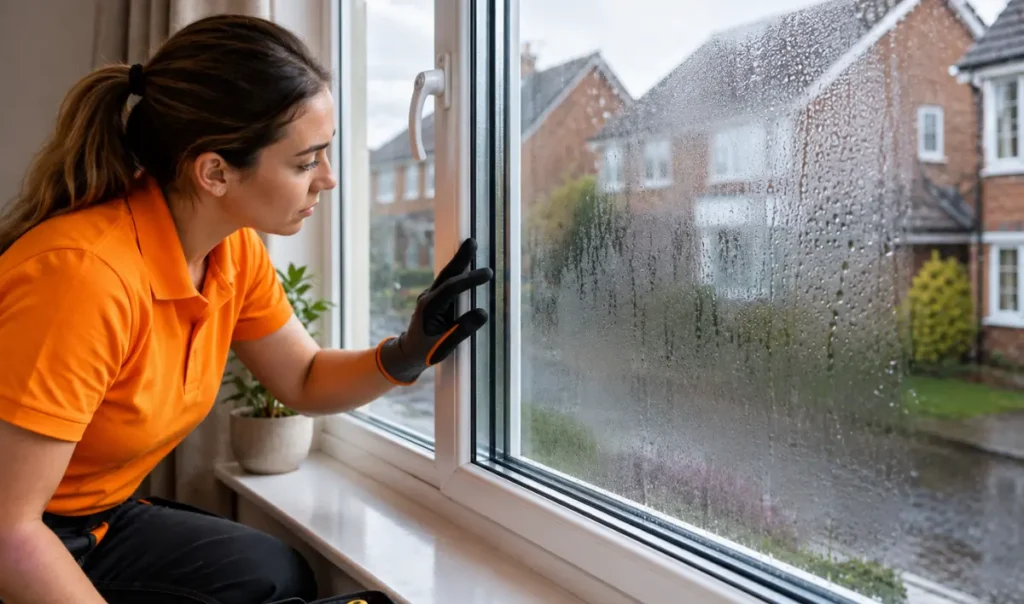
Where condensation sits on your window tells you almost everything about whether it needs fixing. Condensation on the room side of the glass is usually just humidity meeting cold air and clears on its own. Condensation on the outside is weather, not a fault at all. Condensation trapped between the two panes means the sealed unit has failed and will not clear until the unit is replaced.
Most homeowners assume any foggy window is the same problem. It isn’t, and treating the wrong one the wrong way either wastes money or leaves a real fault unaddressed for months.
Why Location on the Glass Matters More Than the Fog Itself
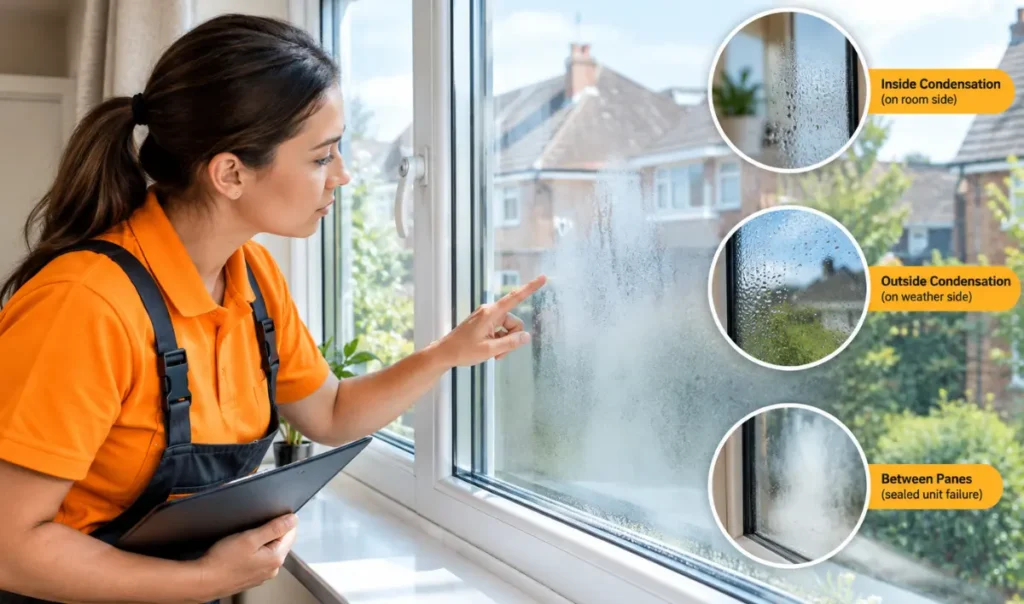
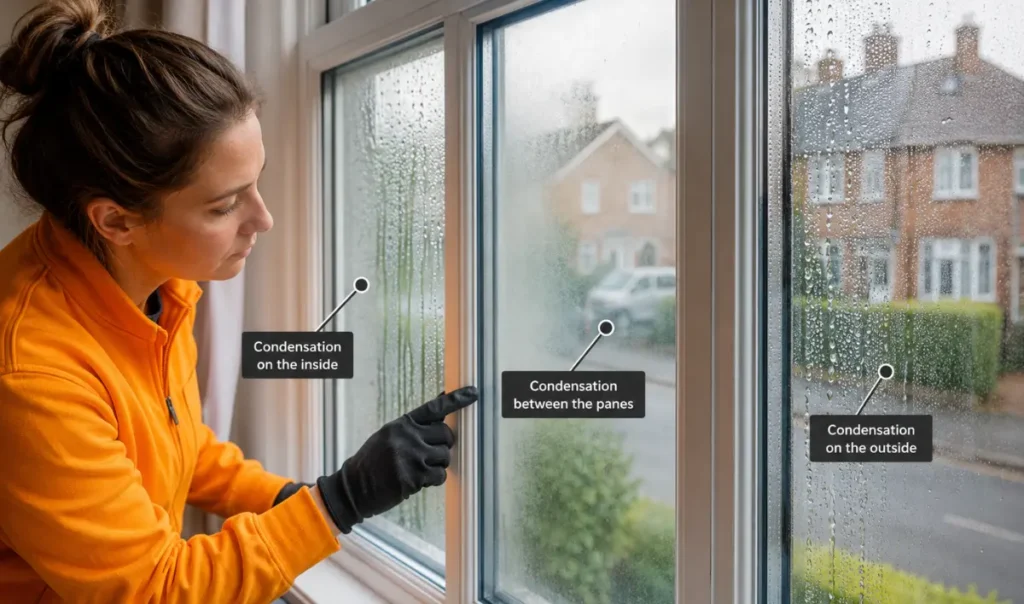
A double glazed window has three surfaces where moisture can appear: the outer face exposed to the weather, the inner face exposed to your room, and the two inner faces sealed inside the unit itself, facing each other across the gas filled gap.
Each of those three locations points to a completely different cause. The fog looks similar from across the room, which is exactly why so many people misdiagnose it. Getting close enough to touch the glass, or trying to wipe it from both sides, is usually enough to tell them apart.
Condensation on the Inside Face
This is the surface you can actually touch from inside the room. If a cloth on the inside clears it immediately, the moisture is sitting on the glass rather than trapped anywhere. This type forms when warm, humid air inside the home meets a cold glass surface, most often on the coldest mornings of the year or in rooms with poor airflow such as bathrooms and kitchens.
It is not a sign of a failing window. It is a sign that indoor humidity is higher than the glass temperature can handle at that moment. Older, single glazed windows show this constantly. Even good double glazing will show it occasionally in a badly ventilated room, since the inner pane is still the coldest surface nearby.
Condensation on the Outside Face
This one confuses people the most because it looks the most alarming, often appearing as a heavy, even mist across the entire pane early in the morning. It is also the least concerning of the three. Outside condensation forms when the outer glass cools rapidly overnight, often below the surrounding air temperature, and morning dew settles on it exactly as it would on a car windscreen or a garden lawn.
Modern, well insulated double glazing is actually more prone to this than older windows, since the improved insulation keeps the outer pane colder relative to the outside air. It typically burns off within an hour or two of sunrise and needs no attention at all.
Condensation Trapped Between the Panes
This is the one that matters. If the haze sits behind the glass, wiping either surface has no effect on it whatsoever, because you cannot physically reach where the moisture is. This means the seal around the edge of the sealed unit has broken down, letting moist air into the gap between the panes where the desiccant inside the spacer bar can no longer keep it dry.
Once this happens, the fog does not clear with weather changes the way surface condensation does. It may fade slightly on warm days and return on cold ones, but it never fully disappears, and it tends to worsen gradually over weeks or months as more moisture works its way in.
A Simple Way to Tell Them Apart at Home
Wait for a morning when the window is visibly misted, then try wiping both the inside and outside faces with a dry cloth.
If the inside clears completely, it was room-side condensation caused by indoor humidity. If the outside clears completely, it was overnight dew and needed no action. If neither side clears and the haze sits stubbornly behind the glass no matter which surface you touch, the moisture is trapped between the panes and the sealed unit has failed.
A torch held at an angle to the glass in a darkened room can also help. Surface condensation shows as fine, even droplets you can see individually. Trapped moisture usually shows as a duller, more uniform haze or, in more advanced cases, a slightly discoloured or streaked patch that never fully lifts.
What Each Type Actually Means for Your Windows
Surface condensation, on either the inside or the outside, is not a repair issue. It is a ventilation or temperature issue, and no glazier can fix weather or room humidity by working on the glass itself. Improving airflow, running an extractor fan in wet rooms, or simply cracking a window occasionally will usually reduce inside condensation over time.
Trapped condensation between the panes is a different category entirely. The seal has failed, the gas fill or air gap is now contaminated with moisture, and the insulating performance of that unit has already dropped. It will not resolve on its own, and leaving it does not make the eventual fix any cheaper. Our misted window repair service deals specifically with this fault, replacing just the failed glass unit rather than the whole window in most cases.
If the frame around a failed unit has also warped or is contributing to a draught alongside the misting, full replacement of that window becomes the more sensible option rather than repairing a unit inside a frame that is no longer performing properly. Our double glazing replacement service covers that scenario when it applies.
Common Mistakes Homeowners Make With Condensation
The most frequent mistake is assuming any foggy window automatically means the seal has failed, then either paying for an unnecessary inspection or ignoring outside dew for years thinking it is a fault. The opposite mistake happens just as often: dismissing trapped condensation as “just weather” for months because it comes and goes slightly with temperature, when in fact the unit has already failed and is quietly losing heat the entire time.
Another common error is only checking the glass once, on one type of morning. Surface condensation on the outside is heavily weather dependent and might not appear at all on a mild, cloudy night, which can make a genuinely failed unit and a perfectly fine window look identical if you only glance at them once. Checking on a few different mornings, cold and mild, gives a much clearer picture than a single observation.
Running a dehumidifier or extractor fan constantly to fight what turns out to be trapped moisture between the panes is another wasted effort. No amount of ventilation reaches the sealed cavity inside a failed unit, since that space is not connected to the room air at all.
Frequently Asked Questions
Can condensation between the panes ever clear up on its own?
No. Once the seal around a sealed unit has failed, the moisture inside the cavity has no way to escape, and the desiccant that once kept it dry is already saturated. The haze may vary slightly with temperature but will not disappear permanently without replacing the unit.
Is outside condensation a sign my windows are performing well?
In most cases, yes. Outer pane condensation happens more often on well insulated double glazing because the improved thermal performance keeps the outer glass colder relative to the night air, which is the same effect that causes dew to form on grass and car windscreens.
Why does my bathroom window mist up every morning but nowhere else in the house?
Bathrooms generate far more humidity than any other room from showers and baths, and that moist air condenses fastest on the coldest surface it meets, which is usually the window. Better extraction or simply opening the window briefly after bathing reduces this significantly.
Does a failed seal always cause visible fog straight away?
Not always. A cold draught, a cooler patch on the frame, or a slight increase in heating bills can appear before any visible haze develops, since the heat loss and moisture ingress both begin from the moment the seal fails rather than from the point it becomes visible.
Will secondary glazing stop condensation from forming between the panes?
No. Secondary glazing can reduce surface condensation on the original window by keeping the glass warmer, but it does nothing for moisture already trapped inside a failed sealed unit, which needs its own separate repair regardless of any secondary glazing fitted in front of it.
Final Thoughts
Not every foggy window is a problem, and not every problem looks urgent. Condensation on either outer surface of the glass is almost always harmless and clears with time or ventilation. Condensation that stays trapped behind the glass no matter what you do is the one that actually costs you money the longer it sits.
If you are not sure which one you are looking at, our earlier breakdown of why double glazing mists up covers the mechanics of a failing seal in more depth, and our piece on what a failed seal really costs on your heating bill is worth a read if you suspect yours has already gone. For independent background on sealed unit standards and accreditation across the industry, the FENSA register is a useful place to check any installer’s credentials.
If you have checked both sides of the glass and the haze still will not shift, get in touch with our Southampton team for a straightforward assessment before it costs you another season of heating.