
The window and door checks when the clocks go back that matter most are the ones that prove every lock engages, every door pulls shut firmly and every sash closes tight before the long dark evenings begin. A fault you can live with in bright light often becomes a real problem the moment you are locking up in the dark.
That is the pattern we see across Southampton every winter. Nothing has suddenly broken. The light has simply changed, and a stiff lock, a loose handle or a draughty frame is now being used, tested and noticed at the exact time of day when it matters most.
The Faults That Tend to Surface When You Start Coming Home in the Dark
If any of these sound familiar, your windows and doors are telling you something before the weather gets properly cold:
The key needs wiggling, lifting, or a second attempt before the lock turns
Handle that has gone loose, gritty or no longer springs back to its resting position
A door that has to be pulled or lifted to engage, instead of closing firmly on its own
A thin strip of light or a cold line visible around a closed frame
Window that sits slightly proud of its frame even when the handle is fully locked
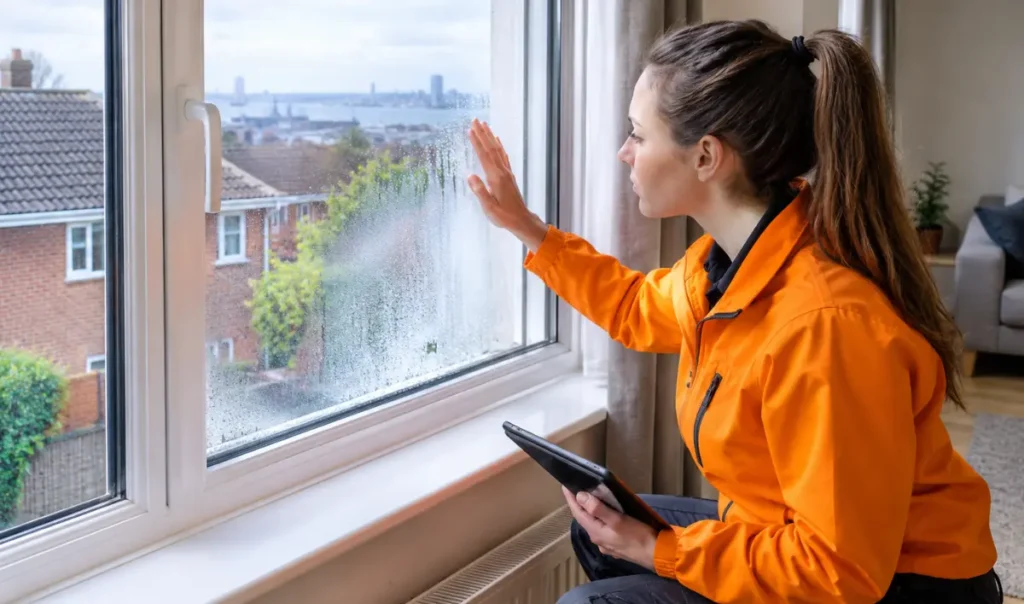
Grey haze, streaks, or droplets between the panes that show up under lamplight
Hinges or stays that squeak, grind, or let a sash sag
Vent or restrictor that no longer holds its position
None of these needs to wait. Most are quick repairs when caught early, and every one of them is easier to fix before the colder weather arrives and the daylight hours available for a visit get shorter.
Why a Change in Light Exposes Problems You Have Been Living With
You Stop Looking at Your Doors and Start Relying on Them
During long bright evenings, a front door is something you pass through. Once it is dark, it becomes the barrier between the house and the street, and you are far more aware of whether it feels solid behind you.
That is when people notice the door that needs a shoulder against it to latch, or the lock that turns with a faint grinding sound. The fault was probably there for months. The routine around it just changed.
Locking Up Becomes a Daily Habit Rather Than an Occasional One
In the lighter months, plenty of windows stay on the vent or slightly open all day and are barely handled. With the early dark, the whole household starts closing and locking everything each evening, often several rooms at a time.
That extra use is what exposes worn mechanisms. A handle with a tired spindle, a lock gearbox that has begun to stick or a keep that has drifted out of line will all show up once they are being operated daily. If you suspect a lock rather than a handle, it helps to get a worn lock mechanism properly repaired before it jams while you are standing outside in the cold.
Lamplight Is Surprisingly Honest About Glass
A lit room at the end of the day shows things that daylight hides. Sealed units that have begun to fail often look fine in strong natural light, then reveal a cloudy patch or faint mineral trails when a lamp sits behind or beside them.
If a window looks a little milky in the evening but clear in the morning, it is worth checking whether the moisture is on the room side of the glass or trapped inside the unit. A cloth wipes away the first kind. The second kind stays put, and it only gets more noticeable as the heating comes on.
A Torch Walk Round That Takes Ten Minutes
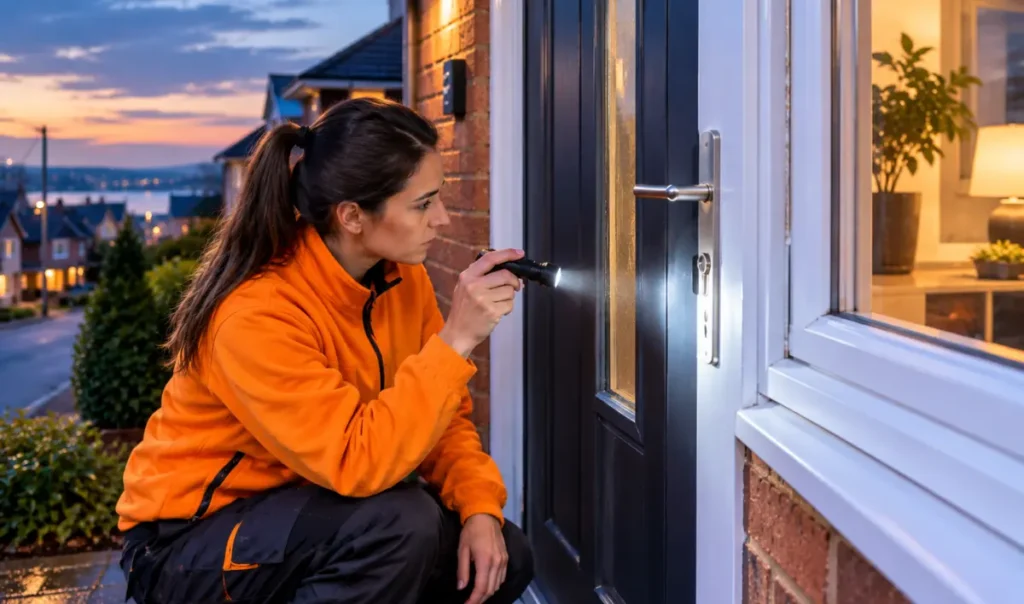
You do not need tools or experience. You need a torch, a dark room and a little patience. Doing this in the evening is the point, because the contrast does the work for you.
Start With the Doors
Switch off the lights in the hallway. Close the front door and look along all four edges from inside.
Any line of light from outside, or a cold stripe you can feel with your hand, means the door is not compressing its seals evenly. That often points to a hinge that has loosened or a door that has dropped slightly in its frame.
Then lift the handle and turn the key slowly. A healthy lock moves smoothly, throws its bolts with a confident clunk and does not need you to hold the door in a particular position while you do it. If you have to push, lift or lean to make it lock, that is a mechanism or alignment problem, and a door that drops or catches on its frame is usually fixable without replacing the whole thing.

Move On to Each Window
Close the curtains on one side of a room and shine the torch from outside, or ask someone to hold it while you look from inside. Gaps around a sash show up as thin bright lines.
Press gently on the closed sash near the handle. It should not move or rattle. Lift the handle, then try to open the window without turning it. A sash that can be pushed open when the handle is in the locked position is not doing its job, and it is worth sorting out the same week.
Check the Hardware You Rarely Think About
Look at the stays, hinges and restrictors. Friction stays that no longer hold a window open, or restrictors that have gone slack, are easy to overlook until you rely on them for night time ventilation.
Finally, look at the gaps around each frame from outside with the torch. A bead of sealant that has shrunk away from the brickwork or cracked along a corner is an early warning for cold air and, eventually, damp.
Locking Up Properly Without Locking Yourself In
This is the part that most articles on this subject leave out, and it matters.
A well locked window is only a good thing if you can still get out in an emergency. Bedroom windows in particular are often designed as an escape route, and many locks are keyed so that the sash cannot be opened without the key in place.
The safest habit is to decide, as a household, where the window keys live and to make sure that everyone who sleeps in a room knows exactly where to find them in the dark. Keeping them somewhere easy to reach, but out of sight from outside and away from letterboxes and glass panels, is a sensible balance. The Hampshire and Isle of Wight Fire and Rescue Service publishes practical guidance on planning and practising an escape route, which is well worth reading alongside any security check.
The same thinking applies to doors. A door that locks with a key on the inside should have that key kept in a consistent, reachable spot, not hidden away in a drawer on the other side of the house.
If you have noticed that a lock is stiff or a key is hard to turn from the inside, treat that as both a security fault and a safety fault. A mechanism that is difficult to operate calmly is a mechanism that could fail at the wrong moment.
When the Heating Comes On, the Seals Start to Show Their Age
Early cold evenings are usually the first time the heating runs properly after a long gap. Rooms are closed up, doors are shut and warm air meets cold glass again.
That is when failing seals tend to reveal themselves. You may notice a cold patch near the edge of a pane, a faint film that wipes off one side but not the other, or a corner of a frame that feels noticeably colder than its neighbours.
You do not need to diagnose it perfectly. What matters is noticing a change from how that window behaved before, and getting it looked at while the weather is still mild enough for a glazier to work comfortably and while parts can be ordered without delay. If a pane stays hazy once you have wiped it, it is often a sealed unit issue rather than a cleaning issue.
Why It Pays to Book a Repair While There Is Still Daylight to Work In
Glazing repairs are done in daylight. Measuring a sealed unit, checking an alignment and replacing a lock cylinder all need good light and open access to the frame.
As the days shorten, the number of useful working hours in a day shrinks. As the weather turns, more households ask for repairs at the same time. The result is that the same job can take longer to schedule once winter has properly arrived than it would have a few weeks earlier.
There are a few practical ways to make a repair visit smoother:
Take clear photos of the fault in daylight, including the lock, the handle and any visible gap
Write down which rooms are affected and whether the problem is worse in wet or cold weather
Note any numbers or markings you can see on a sealed unit spacer bar
Make sure the area around the window or door can be reached easily
Mention if you rely on a particular door as your main entrance, so the repair can be planned around it
If you want a sense of how repair work is organised across the SO postcode areas, that guide explains how visits are usually planned around different parts of the city.
What the Dark Evenings Look Like Across Southampton and the Surrounding Towns
Every neighbourhood has its own mix of housing, and the faults that show up first tend to follow the type of property.
In the city itself, homes in Shirley, Portswood, Bitterne, Woolston, Millbrook and Lordshill range from terraces with front doors opening almost straight onto the pavement to larger family houses with side gates and back gardens. In terraces, a front door that does not lock cleanly is felt immediately because it is the only barrier between the hallway and the street. In larger houses, the weak point is often a side or back door that is used less and neglected for longer.
Moving out, properties in Totton, Hedge End and Eastleigh often include a mix of older frames and more recent estates. Newer homes tend to have patio doors, garage side doors and a larger number of windows that all need to be locked each evening, so a single worn handle is easy to miss. Chandler’s Ford and Romsey have a similar spread, and many owners there are surprised by how many separate locks a typical household closes at the end of the day.
Further along the coast and inland, Fareham and Winchester include a high number of older properties where frames, hinges and hardware have had years of heavy use. In those homes the issue is rarely a single dramatic failure. It is usually several small signs of wear that add up to a door or window that no longer feels trustworthy.
Wherever you are, the principle is identical. Test everything in the dark, fix the small faults early and do not wait for the first really cold night to find out that a lock has stopped working.
Mistakes People Make When the Evenings Close In
Forcing a Stiff Handle Instead of Finding the Cause
A handle that resists is telling you something. Forcing it can snap a spindle or damage the locking gearbox, turning a small fix into a bigger one.
Treating a Lock That Mostly Works as a Lock That Works
If a door only locks when you lift it in just the right way, it is not secure in any meaningful sense. A mechanism that works most of the time will eventually fail at the least convenient moment.
Relying on Gadgets to Cover a Hardware Fault
Timers, lights and cameras all have their place, but they cannot make up for a window that does not lock properly or a door that does not latch. Fix the physical weakness first.
Leaving Every Repair Until Something Fails Completely
Small problems get worse under daily use. A loose handle becomes a broken handle. A slightly sagging sash becomes a window that will not close at all.
Ignoring Upstairs and Back Windows
Ground floor doors get the attention, but upstairs windows, bathroom windows and rear doors are used just as much and are often checked least. Include every opening in your torch walk.
Frequently Asked Questions
Should I check my windows and doors when the clocks go back?
Yes. The change brings early darkness, which means you will be locking up, arriving home and relying on your doors and windows in low light far more often. A short evening check with a torch finds loose handles, stiff locks, gaps and failing seals while they are still simple and inexpensive to repair.
Is a door that only locks if I lift the handle safe to leave?
Not really. A door that needs lifting, pulling or leaning on to engage usually has a worn mechanism or a frame alignment problem. It may feel locked, but the bolts may not be seating fully in the keeps, so it is worth having it looked at promptly.
Can I leave a window on its restrictor or vent overnight?
Many households do, and modern restrictors and vents are designed for that purpose. The important point is that the restrictor should hold firmly in position and the window should not be able to be pushed further open from outside. If the restrictor feels loose or the sash moves freely, have it adjusted or replaced first.
Should window keys be removed and hidden at night?
Think about safety as well as security. Keys should be somewhere every adult in the home can reach quickly in the dark, particularly for bedroom windows that could be needed as an escape route. They should also be kept out of sight and away from anywhere that could be reached from outside.
What if a lock fails after dark and I cannot secure the property?
A temporary measure is often possible, and a glazier can usually make a door or window safe at short notice. It helps to understand what an out of hours call out involves before you need one, including what can be fixed on the spot and what may need a follow up visit.
Final Thoughts
The shift to darker evenings does not create new faults in your windows and doors. It simply makes the existing ones harder to ignore. A stiff lock, a drifting handle or a failing seal is far easier and cheaper to deal with when you spot it early than when it fails on a cold, dark evening.
A ten minute torch walk round each room tells you almost everything you need to know. If you find something that does not feel right, or you would simply like a professional to look over the locks, handles and seals before winter sets in, the team at Glaze Repair Southampton is happy to talk it through and arrange a visit across Southampton and the surrounding towns.